


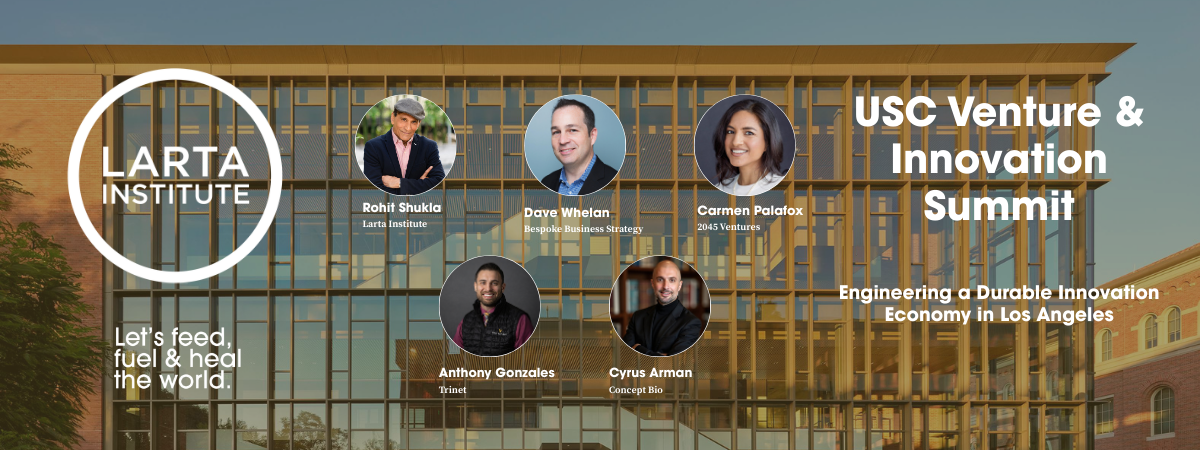
Engineering a Durable Innovation Economy in Los Angeles
February 25, 2026 – 03:00 PM Pacific Daylight Time
At the USC Venture & Innovation Summit on February 12, Rohit Shukla, CEO of Larta Institute, led a discussion between prominent leaders across biosciences, aerospace, venture capital, and health innovation to explore the evolution of Los Angeles as an innovation hub.
As Rohit opened the panel, he declared that LA is already an innovation hub.
The more consequential question is whether LA can become a coherent, durable, and repeatable innovation system – particularly in sectors where it has historic and structural strength such as aerospace and biosciences.
Los Angeles is home to world-class research institutions such as USC, UCLA, and Caltech. It has more PhDs than any other U.S. city. It leads in aerospace, biomanufacturing, advanced manufacturing, digital entertainment, and digital health. It has more than ten world-class hospital systems and is one of the most diverse populations in the world, positioning it uniquely for inclusive clinical trials and community-based innovation.
The issue is not capability. It is coordination.
One of the themes intentionally surfaced during the discussion was the under-leveraged potential of LA’s clinical infrastructure. With its scale, diversity, and institutional density, the region should be a global leader in clinical validation and deployment. Yet collaboration across institutions remains fragmented. The opportunity is not simply more funding, but stronger alignment across hospitals, research centers, and commercialization pathways.
The conversation also examined the evolution of aerospace. While the sector contracted in the 1990s, it has since revitalized through private sector innovation, space technologies, and advanced manufacturing. LA retains a deep industrial base in precision engineering, materials science, and complex systems production. This builder culture differentiates the region from purely software-driven ecosystems and positions it to scale capital-intensive innovation.
In biosciences, the opportunity extends beyond research leadership. Nearly 60 percent of employees in bioscience-related roles do not hold graduate degrees. Biomanufacturing and production capacity represent an opportunity for inclusive economic growth and workforce participation at scale. An intentional bioscience strategy must therefore integrate commercialization, workforce development, and infrastructure investment.
Capital remains part of the equation, but not the sole driver. Venture funding dynamics increasingly favor larger funds and later-stage outcomes, creating pressure at the earliest stages of company formation. At the same time, Los Angeles possesses significant pools of private capital. The challenge is translating that capital into structured pathways that support validation, scale-up, and long-term regional anchoring.
Taken together, the discussion pointed to a broader systems challenge: alignment. Alignment between aerospace revitalization and manufacturing capacity, between clinical institutions and deployment pathways, between patient capital and early-stage innovation.
At Larta Institute, this alignment has been central to our work for more than three decades. Founded during the aerospace contraction of the 1990s, Larta has deep roots in the commercialization of science, technology in the biosciences, agricultural biotechnology, atmosphere and the marine environment and deep tech. Through longstanding partnerships with federal agencies including NIH, NSF, USDA, NOAA, NIST, and DOE, Larta supports innovators nationwide and translate those pipelines into place-based validation and deployment through local initiatives such as Heal.LA.
Los Angeles is a complex and decentralized region. That complexity can create friction. It can also create resilience and scale.
The next chapter will not be defined by whether LA can attract innovation. It will be defined by whether the region deliberately chooses to build the connective systems that make aerospace and bioscience leadership durable, inclusive, and investment-ready for the long term.